








































“Hello Ms. Swati, we have two girls—15 and 12 years old. Their mother is in the hospital with their 8-month-old sibling; both came in with bruises. Child Protective Services picked the girls up from school. We don’t have much more information right now. We’re looking for a home for the next few days while we figure things out. Could we bring them to you?”
I looked up at Mark, who was listening on speaker. We didn’t need words. “Sure,” I said.
“Thank you. The case worker will be there in about an hour.”
This is the nature of a call from DSS—Department of Social Services—to foster parents like us. At a moment’s notice, you become parents to children you’ve never met, for a length of time no one knows.
An hour later, I opened the door.
The sisters stood there, their belongings stuffed into two black trash bags—what they were given when taken from school to pack: clothes, books, maybe a favorite toy. At a moment’s notice, children who belonged to a family, become foster children, moved by an adult they don’t know into the care of adults they’ve never met, for a length of time no one knows..
In foster training, they ask us to imagine everything that makes our life feel like home—our families, routines, familiar smells and sounds. Then there’s a knock: you have 30 minutes to pack. No one can tell you where you’re going, how long you’ll be gone, or if you’ll ever return. Every question is met with “I don’t know.” Now imagine that as a child – when the adults you trust don’t know what to do either.
I looked at the sisters—two pairs of eyes holding confusion, fear, and sadness. My own eyes filled.
“Hello,” I said, offering my hand. The younger one took it with a shy smile. The older one did, politely, out of obligation. Mark greeted them gently, keeping a respectful distance.
The case worker left.
I offered drinks and cookies. They were hungry; they ate everything. The older one – let’s call her Lucy – was surprisingly open. We learned about a third sister, eight years old, placed in another home. We only take two.
Until recently, all three had lived with their father and grandmother. After his untimely death due to an accident, they were placed with their mother and stepfather. These girls were no strangers to life changing at a moment’s notice.
Lucy didn’t say much about life with her mom & stepdad. She didn’t have to. She wanted to go back to their grandmother—and was worried sick about her youngest sister, whose birthday was the next day.
Lucy had already become a mother.
After a while, she asked if they could go upstairs.
“Of course,” I said.
“And later we can go to the store and pick out dinner,” Mark added.
At Stop & Shop, we bought whatever they wanted—comfort food, small indulgences. The younger one brightened, delighted by the freedom.You don’t teach a child about healthy eating on the day their world falls apart.
Lucy grew quieter as the evening went on. Back home, she disappeared upstairs. I asked the younger one what she was doing. She shrugged, focused on her own mac and cheese.
“Want to watch The Prince of Egypt after dinner?” I asked. She nodded.
Then the doorbell rang—at the back door. At the same time, I heard the front door open.
Two police officers stood outside our back door.
“You called?, they asked.
“No!”
“Well, someone did.”
Concerned my cat might escape, I asked them to step in so I could shut the door! Slightly bemused, they obliged.
We walked toward the front – and that’s when I saw Lucy, outside, sobbing. “I’m sorry, I’m so sorry. I was scared. I shouldn’t have done this.” she said, throwing her arms around me.
In her fear and desperation, Lucy had called 911. She told them she didn’t know where she was and wanted to go back home.
The officers watched as I held her, telling her it was okay – that she wasn’t in trouble. They thanked us and left.
I asked Lucy if I could speak to her grandmother on the phone. She agreed.
I learned from grandma that she had been driving back from Philadelphia when the girls were removed. When DSS asked the mother if there was a relative, the mother had said no. Maybe there was history. Maybe fear. But at a moment’s notice, the girls became children in the system.
I made a decision.
“Can you come see them tonight?” I asked grandma.
It wasn’t by the book – you can’t always trust the adults in these children’s lives. But sometimes the book doesn’t know what to do either.
Within thirty minutes, the grandmother and the girls’ aunt arrived.
We gave them space. The house filled with reunion—hugging, crying, voices softening. The grandmother promised she would file for custody the next day.
Before she left, grandma hugged me – a tad longer than expected, warm, full of something deeper than words.
The rest was simple. She followed through. The girls went to grandma in a few days.
I remember the smile Lucy gave me as she left. Maybe she learned that sometimes, even when no one has answers, some adults still know what to do.
Fostering isn’t for everyone. You need a heart of velvet and nerves of steel – and a lived experience helps. I saw my own mother die as a young teenager. In a moment, my life changed forever.
So I know what a moment’s notice can take from you. But sometimes, if you’re lucky – and if someone shows up with care & a quiet inner knowing that goes beyond words or logic – it doesn’t only take.
It can also give, at a moment’s notice.
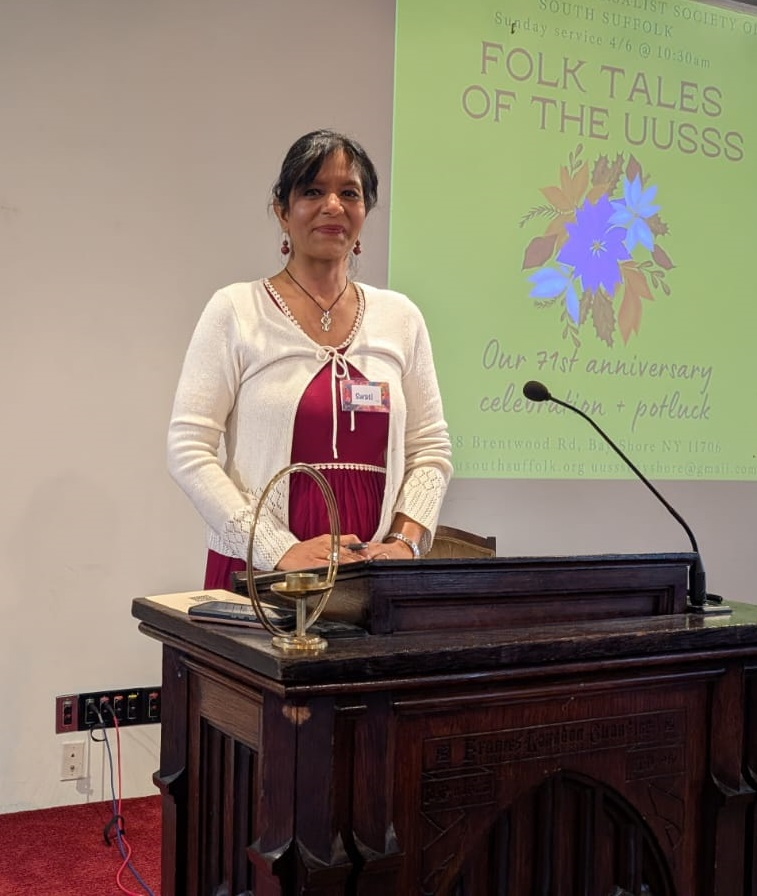
Swati Srivastava is an immigrant and a multi award-winning writer, director, and voiceover artist. A filmmaker & storyteller, Swati turns ideas into experience. She it the Co-Chair for Braver Angels Long Island and a trained facilitator for Crossing Party Lines moderating conversations that bring people together across their political divides. Swati is also an environmentalist and lives in a Net Zero Energy home with her husband. She can be reached via Linkedin and swati@TiredAndBeatup.com